Showing posts with label story. Show all posts

Tuesday, March 06, 2012

3 act structure

I was reading this very interesting book yesterday and I stumbled upon this list about the Characteristics of a good story:


·  A single theme, clearly defined
·  A well developed plot
·  Style: vivid word pictures, pleasing sounds and rhythm
·  Characterization
·  Faithful to source
·  Dramatic appeal
·  Appropriateness to listeners
Baker and Greene, Storytelling: Art and Technique, pp. 28


Interestingly enough this list refers to oral storytelling, the kind you do in book-stores to children, for example.
Seems like certain things are universals - I would say key - to a good storytelling, whether you do it in words, talking to people or using images.

My teacher used to say: it's not what you say, it's how you say it that makes a difference.

I honestly don't know if he was quoting somebody or not, but I always loved this sentence.

Now you've come up with a story, you've come up with a set of characters, you have theme, a thesis, a dream and a conflict and you have researched your topic through and through... what should you do next?


You have to put all you have on a structure.
Traditionally, Western storytelling, follows a 3 act structure. (the second act, at times, gets split in halves... but that's your personal choice).

In  Act I you establish a lot of things and create what's usually called Setup.
In Act II you develop things  and it's usually called Confrontation.
In Act III you resolve things and it's usually called Resolution.


Most people seem to underestimate the importance of act II. Actually some things can slow down for a little bit but then you have to pick up again and reach a certain climax.


Sir Thomas Beecham (google him) used to say:  "There are only two things requisite so far as the public is concerned for a good performance: that is for the orchestra to begin together and end together; in between it doesn't matter much".


Well in storytelling, actually, if you fail the stuff in the middle - the second act - it does not really matter how good the beginning and ending are.  People will leave!


The point is most stories do fail the second act because they don't realize is about character development.


Nowadays, though, most people seem to forget how messed up the second act is the moment some kind of twist in the ending makes the movie worth while.


We will talk in details about each individual act next time.


Index
1) Know your story
2) What if...?
3) Theme and thesis
4) The In and Out of storytelling (the dream)
5) Memorable and Meaningful
6) Target
7) A narrative tone
8) A storyteller
9) Why love your sketchbook
10) Call back and reincorporations
11) Dream vs. Conflict

Monday, February 20, 2012

Dream Vs. Conflict

Today we talk about Conflict and how it must relate to the character's dream/goal in order to make the dilemma more believable.

We already saw in a previous post called "The in and out of storytelling" (check the index at the bottom) that there can be many typologies of dreams but all can be summarized in two categories: the character looks inward or the character looks outward.

How many categories of conflict are there? Well, mainly two, internal and external, just like for the dreams... but the conflict can also be broken down a little more and go specific.

here they are:


- Man vs. Destiny: this type of conflict is one of the oldest ever invented.

Let's face it, original died with Homer and so it is obvious that he would use this conflict in the most archetypical story of all times: the Iliad. In form of gods, prophecy or legend Destiny had dominated stories whose protagonists are always Chosen Ones on a Quest (the quest applies to most stories, so does the Hero's Journey, but some stories are more literal than others and therefore deserve to be called epic).
Think about Oedipus and how he cannot escape his fate: to kill his father and wed his own mother.
Think about Neo, who is the chosen one, and how he was given a false prophecy to be forced to fulfill his destiny.
Think of the Skywalkers and how they were destined to stumble upon each other.
Or even, more recently, Scott Pilgrim who even has a book entitled: vs. Destiny.

Fate is something you cannot escape. He is your father. LOL.

- Man vs. Himself is also referred to as: internal conflict.

Some characters are a bit emoting or have problems and they have to resolve their own internal conflicts before they can take on the World.
If you think about American Beauty, even though Larry is vexed by his family, his internal conflict is what keeps him bound to his situation, lack of self esteem, his passive self. The moment he finds his dream, something to live for, he decides to take care of himself, this restores his self esteem and he manages to confront the rest of his problems with strength.
The inner conflict is also represented in Star Wars - The Empire Strikes back, in the scene where Luke enters the cave and Yoda tells him that he will find in there only what he brings with him.

 - Man vs. Man: this is the classic antagonist vs. antagonist.

Usually this is the case where the dream of our protagonist is directly clashing against the dream of the antagonist. Think about hero vs. super-villain kind of story: one wants to save the Earth the other one wants to conquer it. This is the kind of story where two characters compete for the same role/position/or girl. So they are against each other... as Pro- in protagonist stands for "in favor" and the Anti- in antagonist stands for "against".

In Man vs. Man I usually would put a smaller branch, although many may not agree with me: man vs. technology. I think one of the reason why I put it under man vs. man is that usually it's a one on one type of conflict. Man vs. machine (like in I-Robot) usually have a machine that has been built by a man whose dream was in conflict with the one of our hero -  ironically in conflict. In War Games, Josh had been built with the hope that he might learn from his mistakes, the hero of the story just wants to play a game instead and finds himself in a lot of trouble. So somehow I feel that behind the machine there is always a human mind/intention... even Hal from "2001: A Space Odyssey" was not supposed to do what he did and he did what he did because of the way he was programmed.
- Man vs. Nature: external conflict again.

This one is a very hard to overcome because we are part of Nature, you can think of them as survival stories. You cannot defeat nature completely but you can survive that stuff Nature throws at you. If you think about The perfect storm, it's quite evident who has the upper hand. Usually catastrophe movies go in this category but let's not forget Jaws (although, as far as Spielberg is concerned his experience was Man vs. technology since the mechanical shark kept sinking) or movies with giant creatures (alligators, anacondas, squid, octopuses, bears, etc.).

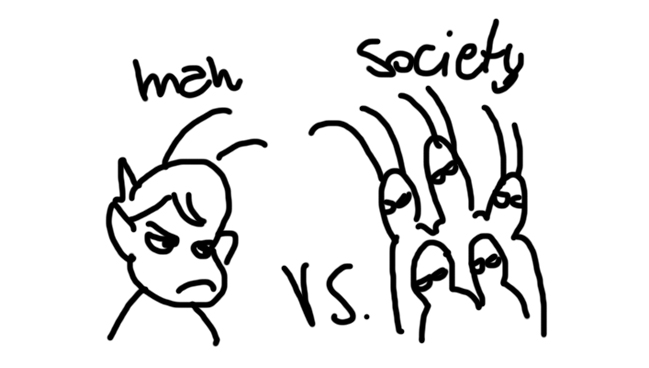
- Man vs. Society: this one is a tough one and usually has a revolutionary concept behind it. It's about human rights or legal rights and stuff like that. Think about Philadelphia a movie that makes a stand in favour of gay rights and brings the protagonist's case to court challenging the whole system to raise awareness on a difficult topic. But even if you look at small little stories like A Bug's Life... the society of ants really does not trust and think well of Flick at first and he has to make a way into the World to prove himself to the society that is supposed to accept changes but does not want to.

Once you determine the nature of the dream of your character it is important to choose a proper type of conflict to oppose it.


Clearly if you choose a sport theme you have to find an antagonist for your protagonist. Imagine how funny it would be to see Rocky Balboa struggle against a twister to be able to train! His goal in life is to become a boxing champion, you have to give him an Apollo Creed!

Conflict and goal balance off each other. Pick a main one first (you can add little subplots and subconflicts later too) and work around it.

The clash between these two will create the struggle, the situations and the stress that will help your character go from an assemblage of characterizations (his trait) to a true human being.

As Rob mcGee teaches us: True CHARACTER is revealed in the choices a human being makes under pressure - the greater the pressure, the deeper the revelation, the truer the choice to the character's essential nature.

Index
1) Know your story
2) What if...?
3) Theme and thesis
4) The In and Out of storytelling (the dream)
5) Memorable and Meaningful
6) Target
7) A narrative tone
8) A storyteller
9) Why love your sketchbook
10) Call back and reincorporations

Monday, January 23, 2012

A narrative tone

A narrative tone is something that belongs uniquely to you.

Some people might take years to discover what their narrative tone is all about, others are just born with a natural talent of making things concise and funny or elaborate and scary.

A narrative tone can be achieved in many ways but it's one of the things that also help you define the genre of your story and the target.

Remember when I previously mention to keep an eye on your target?
Well you can not use complicated expressions or sophisticated lexicon if you are meaning to target children, children have a smaller vocabulary than adults.

Also you cannot make sexual innuendos or scary foreshadowing for them. You have to keep your narration preppy and most of all avoid a condescending tone: and do you know why he's going to die if he sets foot into the hall? Let me explain you, little children, since you are to young and stupid to figure it out by yourself!

No, no, please don't do that.

What kind of narrator are you? You'll have to figure out yourselves. My suggestion is, whatever you do, don't be the type that takes everything too seriously, including yourselves and your story.
I strongly believe that if you hold nothing sacred you lead a happier life and you can explore more things.

Now I don't mean to say you need to be offensive, there are certain topics I would never touch (like religion) because they tap into people's beliefs. So when I say not to keep anything sacred I mean particularly your own creations.

That's why, after I painted a pretty picture of Kes with her cute pregnant belly... the next thing that came to my mind was her true nature. That's what I called the drawing in this post on Deviant Art: "true nature".
We know what Kes looks like when she is in locust mode, right?

I once met Chuck Palahniuk during a writing workshop held in San Francisco. He often speaks about moment of humiliations for the characters. To make it simple without hopefully corrupting his concept too much he said on that occasion that a good way to show nice, rounded characters is to give them authority and take it away putting them through moments of humiliations. That's when their humanity shines through and you see what stuff they are made of.

He mentioned in that occasion this accident he witnessed while watching TV in his motel room. He said the anchor woman started weeping while reading the news. To him it was astounding how up until a few moments before she had such authority, after all she was reading the news, and then all of a sudden... bam.. she was crying, the authority fell, she went through a very humiliating moment and he thought that was amazing.

Probably this is the same reason why he always suggest to tell the story in first person. First person has more authority and autenticity - he says. He also suggests to hide the "I"(if shows up too often is irritating) with "me" and "mine".

So the type of narrator also helps you define a narrative tone.
1) first person 
2) first person omniscient (they say is a big no no... yet we have American Beauty...)
3) second person (very rare but Calvino used it)
3) third person, subjective or objective, omniscient or limited

A first person omniscient is kind of rare, it means the narrator tells his story after it happened and can try and give you more foreshadowing than desired or does it?

Think about Lester from American Beauty: "My name is Lester Burnham. This is my street. This is my neighborhood. This is my life. I am 42 years old. In less than a year, I will be dead. Of course, I don't know that yet, and in a way, I'm dead already..."

The second person is also very rare and has something of prophetic tone to it: you didn't know you were going to die that day, when you left your house and breathed in the fresh morning air. No, you didn't.

So the most common ones would be a first person or the regular third person. Subjective and objective, omniscient or limited refers of how much this narrator already know of the character. How much in advance and how much he cares and feels for the person he/she is narrating about.

In Stranger than Fiction, the narrator voice over is a typical omniscient and objective narrator. She describes Harold's life in a detached way and throws in a "little did he know"... he was going to die: "This is a story about a man named Harold Crick and his wristwatch. Harold Crick was a man of infinite numbers, endless calculations, and remarkably few words. And his wristwatch said even less. Every weekday, for twelve years, Harold would brush each of his thirty-two teeth seventy-six times. Thirty-eight times back and forth, thirty-eight times up and down. Every weekday, for twelve years, Harold would tie his tie in a single Windsor knot instead of the double, thereby saving up to forty-three seconds. His wristwatch thought the single Windsor made his neck look fat, but said nothing."


Sometimes the third person can switch to first, like for Sunset Boulevard: "Yes, this is Sunset Boulevard, Los Angeles, California. It’s about five o’clock in the morning. That’s the Homicide Squad, complete with detectives and newspapermen. A murder has been reported from one of those great big houses in the ten thousand block. You’ll read about it in the late editions, I’m sure. You’ll get it over your radio and see it on television because an old-time star is involved; one of the biggest. But before you hear it all distorted and blown out of proportion, before those Hollywood columnists get their hands on it, maybe you’d like to hear the facts, the whole truth. If so, you’ve come to the right party. You see, the body of a young man was found floating in the pool of her mansion with two shots in his back and one in his stomach. Nobody important, really. Just a movie writer with a couple of ‘B’ pictures to his credit. The poor dope! He always wanted a pool. Well, in the end, he got himself a pool," only the price turned out to be a little high." - as you see... the narrator, Joe Gillis, he is actually talking about himself.


This website here has a very good list of narrators or voice over that can help you figure out what kind of narrative tone you want for your story. He provides some good example... as you see... Charles Kaufman is in there too. He is only number 10 but you see Adaptation is one of those movie that proved how much you can actually stretch storytelling as long as you do it in an original way.

Friday, December 16, 2011

Target

Alright before you go ahead and tackle your conflict there is one more thing I need to mention. Silly me not to have mentioned it before, but see both the dream and the conflict rotate around one fundamental factor: who are you writing this story for?  What's your goal?

These two questions can be summarized in a simple word: target!


Let's analyzed them. If you are writing this story for yourself and yourself alone then you can ignore everything I am going to say next. If you are crafting this story around an audience the second question needs to tap in and affect the answer to your first one.

If you are making a story for others then ask yourself: who? and what for?

For money... you can skip what I will say next. All you have to do is make it completely wrong, dumb, ugly and post it on your blog with lots of advertisement. The internet has changed the World, turning people into trolls and lots of people like to feel good about themselves by bashing others. I thought I was the only one complaining about this phoenomenon until I read this article:If you want your piece to go viral, it's smarter to make a cringe-worthy video rather than an awesome one, because they know our asshole nature will get us passing it around. And they're right." - and then he says - it's a proven fact that we are horrible dickheads who love to just point and laugh at other people's failed attempts at creativity. We refuse to just let it slide when someone shows us something like Why Must I Cry opting instead to laugh them out of existence."

So I was reminded of how many of my friends spend their time talking about stuff they dislike and yet when I always the question: but if you hate it so much, why do you keep on reading it?
The answer is always: because it's so bad, I want to see if it gets worse.

So here's the solution to your money problem, make it super bad, send it viral, become Rebecca Black (you know, right, she was "built" to make money off of trolls!) and you are settled for life.


But now let's go back to serious creation, the one that will make you die happy but starving... but happy, but starving, but happy, but... I could go on for ever.

Choose your target audience and never forget who you are writing for. 
Some stories may start as kids stories and change along the way as the audience grows old and mature with the characters (long running series like One Piece, for example, do that).


You make sure that right from the start you hint at elements that even though, right now, are not there (like death), they might be there in the future and that is a warning, a warning that says: I am starting G, but I'll go T+.  If you don't do that then you are bound to stay in you G for ever and ever, it's a matter of honesty.

So... is your story a story for children or adults, is it for boys or girls?
Sometimes making these kinds of decisions not only will craft the narrative tone of your stories but even whether or not they are plot based or character based.

The younger the audience the more the plot will take over. Older audiences are into character development instead.

Children tend to like stories with more plot and a proactive protagonist who is also one of those OUT characters that will move mountains and stuff.

If the hero makes no effort to gain the happy ending they will blame you for telling a lame story.

Girls don't dislike slower pace and IN characters.

Older audience love slice of life, historical things, period dramas and such.

The choice of your target audience will also affect your color schemes and packaging. 
The younger the audience the more vibrant the colors will be.
You give a black and white comic to a five years old, he'll grab his crayons and color it for you (and that's what my nephew did to my comics, they look much prettier now).

Now let's say you are crafting your story around teenagers... good luck. The market is literally gone to crumbs and the invasion of the ultratrolls has lowered the quality of the language spoken by a lot. You will have to spoon feed a lot, while keeping a zillion subplots that, sometimes, are really not useful to the story at all. You will be a servant to the market and will be crafted by the market. You will be forced to obey the audience... if you want to survive. If you don't obey they leave you.

This is how the Japanese market was molded by his fandom and forced to create harem stories with particular stereotypes included: meganekko, antenna girl, chibi, lolicon, and so forth. One character for every slice of market.

You cannot afford a lot of nicely rounded characters and have to stay a bit flatter, making sure your hero is always politically correct. The moment they stop loving rainbows and unicorns or whatever thing is in fashion, the audience will accuse him of monstrosities and leave him. The moment his love is not devoted or is awesomeness is not bad-ass even when he does not win... he is done for.

Teenage market is very whimsical but if you go for it choose to write for girls as a female audience is more loyal than male readership.

All of this comes from many years of reports and numbers, coming from the marketing department, of a famous publisher I was working for. The Italian would say: carta canta e vilan dorme (paper signs and farmer sleeps). It's the paper talking here... the paper is valid even when the farmer forgets about it... unfortunately. I can only warn you and nothing more. The final choice is yours.

In the end whatever target you choose and however you decide to tell the story be also reminded of one thing: there are a lot of trolls out there that will throw piles of crap at you for the heck of it.
Trolls are easily recognizable: they don't know what they are talking about and their comments are clearly generic and showing that... they never did read your story to begin with, they are just there to bash you because their lives suck.

Two things you can do with those messages: you ignore them; or you read them, collect them and create a blog around them. People will flock to read your blog even if they  never read your comic... and that's because of the above mentioned article. LOL


Saturday, December 10, 2011

M&M kinda like the candies.

I always like to give these little suggestions using acronyms and such. I think it's easier to remember them and never loose sight of where you start from, so you get to know where you are going.

So we started with a D+D+D and then I added In&Out.


Today, before we tackle the nature of the conflict, I wanted to talk about M&m's... yes kinda like the candies but not really.

Sometimes I forget about M&M's because I take them for granted.

Then today I saw this cheesy t-shirt, when I was riding the train and that's when I thought: oh, yeah, these are two of those things you can never leave out of your sight while you pick theme, thesis, dream and conflict.

What are the M&m's of storytelling? As simple as that: whatever you do make it meaningful, make it memorable.


As I previously stated don't just pick a theme without exploring a thesis: a story with no opinions is not worth reading. Things need to be meaningful, people must be able to related to them. Always start from meaningful... how to make it memorable will come with the crafting of your work.

Definitely find a way to set yourself apart from the crowd. Have your knowledge guide you, go where nobody has gone before... boldly go.

Even though these two words will become more fundamental when we'll talk about empathy, sympathy and appeal... and craft.... I want you to keep them in the back of your mind, like a dark shadow and plan things ahead with a goal in mind: make it meaningful and make it memorable.
So take them into consideration from the very start of your idea.

I know what you are thinking right now, this is a suggestion that is not a suggestion is a Captain Obvious... oh, yeah? Let me tell you one thing: this is a suggestion that is more of a reminder because sometimes people who think they are following M&m's get lazy before they even start and don't want to be bother about it - then their show gets cancelled!

The more obvious things are the ones we never look at.

Thursday, December 08, 2011

The In and Out of storytelling.

When we think about a story we think that our plot will move our character forward and sometimes we get tricked into believing that, no matter what happens, the more things we add the better the story will get.

Truth be told, for storytelling, simple is best. Adding details must be done carefully. The details that don't help your story move forward will hold it back. If they don't support your character, they'll make him/her trip and fall.

If details kill your stories you must kill the details. So it is very important for details to be useful, it is very important to use them to help propel the story forward instead of dragging it down.

That's why it is very important to remember that a story is all about: a dude with a dilemma and how he deals with it. 

But is your dude going to have a dilemma if he is statically accepting what is around him? The dilemma should always arise because the dream and the conflict are clashing.

That's why our D+D+D formula needs an extra smaller D in it: D+d+D+D.
The smaller "d" is the dream and, if you think about it, it is not so small after all. You have to provide your characters with needs and want. Particularly one need and want that will be in contrast with what they have. That dream and want will be the fuel to the engine called: achieving a goal.


If we stop for a second to analyze the stuff dreams are made of we realize that there are basically two types of dreams and wants. I usually play a little game with my students and tell them: Disney movies use a smart move, they don't have enough time to show you the DREAM so their characters will sing it to you. Let's make a list of what disney characters say in songs.
1) Oh, I just can't wait to be king;
2) Just around the river bend;
3) I want adventures in the great wide somewhere, I want it more than I can tell;
4) If only they'd look closer, would they see a poor boy, no sire, they'd find out there's so much more to me;
5) A whole new world, a new fantastic point of view;
6) I can go the distance;
7) When will my reflection show who I am inside;
8) Out of the sea, wish I could be, part of that World;

Oh, I could go on for ever. I was trained in those standards, I know them by heart.

But let's color code and separate them for a second. When you go and look at them closely you'll see that mainly there are some 3 common themes: I want to be someone else, I want to be somewhere else, I want to be me.


The first two look outside and the third one looks inside the character. 


So when creating a type of dream for your character you need to figure out what kind of person he/she is: is he/she an IN kind of guy/gal or an OUT kind of guy/gal?

Is he/she looking at escapism or is he/she looking for acceptance and understanding?

It is very important to establish this because it will help you establish the nature of the conflict as well.

Out kinds of characters will start a journey of discovery that might lead them to realize two things: they can achieve their goal because of who/what they are (the chose ones) OR they come to realize that what they thought they wanted is not how they thought it would be, they might realize that what they had was not so bad after all. So it's either make it or break it.
In kinds of character will start a journey of discovery that might lead others to realize two things: they had misjudged the hero and his/her abilities OR they always believed in the hero but the hero did not believe in himself/herself. Usually is a make it or make it kind of story.

In any case you can have a proactive or a reluctant hero. The Proactive OUT hero dives into adventure to prove something to himself, the Proactive IN hero dive into adventure to prove something to others.
The reluctant hero does not want to go into adventure, whether he is IN or OUT, he believes he has nothing to prove and others are right about him even when they are wrong. Usually this is a hero who has nothing to prove but learns the most.

 In the next post we'll see the nature of the conflict and how it reacts to the dream.

Tuesday, December 06, 2011

Theme and thesis

 In our previous post about "What ifs...?" I mentioned the importance of picking a theme and a thesis.

The two definitely walk hand in hand since the thesis is your opinion about that theme. So let's say you want to talk about the environment then you'd have to develop, in your story, your thesis about it... for example: if we don't do something about the environment we'll kill the planet.


The theme I chose for The Pirate Balthasar is Independence. Although there are individual subthemes for each character, they all lead to the same main theme: I gain independence through acceptance, I gain independence through perseverance, I gain independence through knowledge, I gain independence through giving, and so forth. So think about linking your themes and create a nice hierarchy.

Usually a theme is something you can summarize in one word: perseverance, environment, mourning, loss, freedom. The reason why you pick a theme is because you want to express an opinion about it. If your story does not come with an opinion... it's not really worth reading and that's my opinion (LOL).

It is very important to link your theme and thesis to the character's goal/dream and to the conflict, as well, but we'll talk about dream and conflict in the next post.

Now we need to talk about thesis because thesis are pretty tricky.

As I said: the thesis reflect your opinion on the matter/theme chosen so chose it carefully. Let me mention the example again: if we don't do something about the environment the planet is going to die.

The tricky part is... there are antithesis!

So somebody may answer to your thesis with a: this planet is a rock crawling with life! Life is stronger than anything. If anything, by destroying the environment, we are only killing ourselves and maybe that's not such a bad thing after all. This planet is better off without us.

Because there will be plenty of people whose opinion will diverge from yours you have to make sure you plan ahead and create a response to every possible antithesis... sort of like... predicting an attack and planning a counter attack or a plan B.

How to counter attack such an antithesis? Something like: that is true but it will take the planet eras to heal and nothing guarantees we won't come back and do it again and again! So are we really here, stuck in a loop, to torture the place we live in or can we do something about it? Are we here to live as bacteria or can we live in harmony with the environment and stop this process of endless pain and sorrow for good? And just because I won't be there in the future is that an excuse good in enough not to cherish here and now?

Now these kinds of disputes can go on for ever but you chose how and when to deliver all the possible thesis and antithesis along the story before your audience vomits sentences on you and you should be quite alright. Especially if you state your main idea early on, embed in the hook and in the narrative compromise, the fault will only stand on the shallow mind sitting on the other side and you can proceed scot-free: you performed your duty.

Fundamentally if you respect your theme and thesis you are never bound to stray. You will have to respect the narrative compromise, the hook, the character's goal and dream and keep your clarity in check. We'll talk about narrative compromise and clarity in another post.

For now I end it with theme and thesis because there's a lot to think about. Just remember: you drop a bomb in deep waters and shallow fishes will come belly up. But deep fishes will see it coming.
Use your bombs well and aim for deep fishes.

Wednesday, November 30, 2011

What if...?

Stories usually come from simple ideas, from a simple question that goes like this: "What if....?"

- What if everybody in the World decides to stomp the foot on the ground at the same time?

- What if sharks learned how to fly and started flying around cities?

- What if zombies decided to turn a leaf, became vegetarians and that improved their intelligence to the point they became politicians and stuff?


So before you even think of a character and a story there are a few things you want to think about: thesis, theme and what ifs.

Let's talk about What ifs now.

Storytelling starts from observation and understanding. Life is a story in itself and it is very very interesting, you just have to stop and listen to it.
You have to be: aware of your surroundings, curious and you have to question stuff all the time. Be observant and detached.

A lot of people will tell you that injecting yourselves and your personal experience in your story is wrong, that you shouldn't do that. That depends on how you do it. 
This is something I've heard only in recent times because back in the days, if you were to take a creative writing class, the first thing they taught you was: write about the things you know.


So I have a feeling that these DONTS are just noobs' trend that sprouted around the internet, more of an opinion rather than a fact. I often read and giggle about sentences like: this is good idea and this is a bad idea... coming from people with no authority in the fields. So be careful who you ask your opinion to.

There are no such things as good or bad ideas. Ideas are ideas. It's how you develop them that makes them good or bad.


You cannot talk about yourselves turning your character into a "heroic you without defects" and letting him win all the time... that is wishful thinking. If you think that in that situation you would kick ass, you are not being honest about it and clearly you have never been in that situation.


I remember Osamu Tezuka talking about this point in one of the chapter of Boku no Songoku. He was making fan of his character, Sanzou, for always acting like a coward saying: what a whiner. Then the character turned against him, drop him in the comic, forced him to take his place and, as it turned out, Osamu Tezuka was even more of a coward than Sanzou and ended up apologizing to him.

You have to know yourselves and be honest about it, your faults are far more interesting than your talents. Maybe those are the things you want to inject in your stories.

Quite frankly I think that people always have interesting things to say, and so even when they talk about themselves, their ordinary, everyday, normal little selves... masterpieces are born: Blankets, Portugal, Mom's Cancer, Mauss... LMDV. I could go on for ever. They are gorgeous!

Your what ifs are always born from the things you observe and how your curiosity reacts to them. If you are standing in a white room and you think it's a boring room a what if about color might kick in: what if walls that change colors according to people's mood were invented? What kind of complications might that arise?

They also sprout from your fears. The flying shark idea... that's where it comes from: I am might afraid of sharks. If they were to fly... leaving the house would become quite troublesome... or funny.

So go in the World, observe, ask yourselves question and put down a list of what ifs... you can use more than one in your story. You can use one per character and you can even solve a what if and move onto a second one (that works if you have a serialization going).

But do start from simple questions and write them all down. Ideas are ideas, cannot be copyrighted and a lot of people think about the same ideas simply because we are groomed and molded in the same society.

It's how you develop your ideas that will make you different from others. This is when theme and thesis kick in. I'll talk about them in the next posts.


Monday, November 28, 2011

Know your story.


What's a story?
A Story is something with a Beginning, a Middle and an End. As simple as that.
Your story has to start, go somewhere and then find its way towards the ending. It might seem logic but try and ask this very same question to anybody you know and almost nobody will come up with this answer.
Because it's simple, it's straightforward and it's a bit obvious.

But clearly that is also what a story need: it needs to be simple, linear and obvious.... but don't take this words literally.

Simple is best, linear means you need structure and obvious simply means that everything must be clear enough for everybody to understand, without a reasonable doubt, without interpretations of sort, without way outs.

What are the main elements you need in a story?
You need a character, his environment, you need his dream, a conflict and rising action and then a resolution and then...

No, let me summarize this better. A story needs these elements: D + D + D.

Or to say it better: a Dude with a Dilemma and how he Deals with it.

A Dude is a Character.
The Dilemma is a Conflict.
And how he Deals with it is all the series of Rising Complications that would lead him to the Final Resolution.


A story can be moved by two things: plot and character.
Plot drive stories can be quite tricky and may lead inexperienced writers to character betrayal.
Character driven stories, if not dealt with properly, can lie flat and never go anywhere.

Plot is the series of events that move the story forwards, carrying the character along for a crazy ride.
It needs a good amount of cause and effects.

There can be stories with very little plot but there can never be a story without characters. 

It is one of the reason why a character driven story is to be preferred to the plot driven one. You can have a cool plot and mess up the character, then nobody will believe you... but you can have a cool character keeping together chaotic elements and people will follow you in the ride (let's not forget that most movies have very simple, linear plots and are held together by the charisma of the protagonist).

If you really want to know your story you have to know your character.
Know your character and he/she will move the story forward for you.

Know your character and you shall also know your story. 

Index